How to Bench Press With Proper Form
July 28, 2026
The bench press can build your chest, shoulders, and triceps while giving you a clear way to measure upper-body strength. But small setup errors can make the movement unstable, uncomfortable, and difficult to progress.
Good technique starts before the bar leaves the rack.
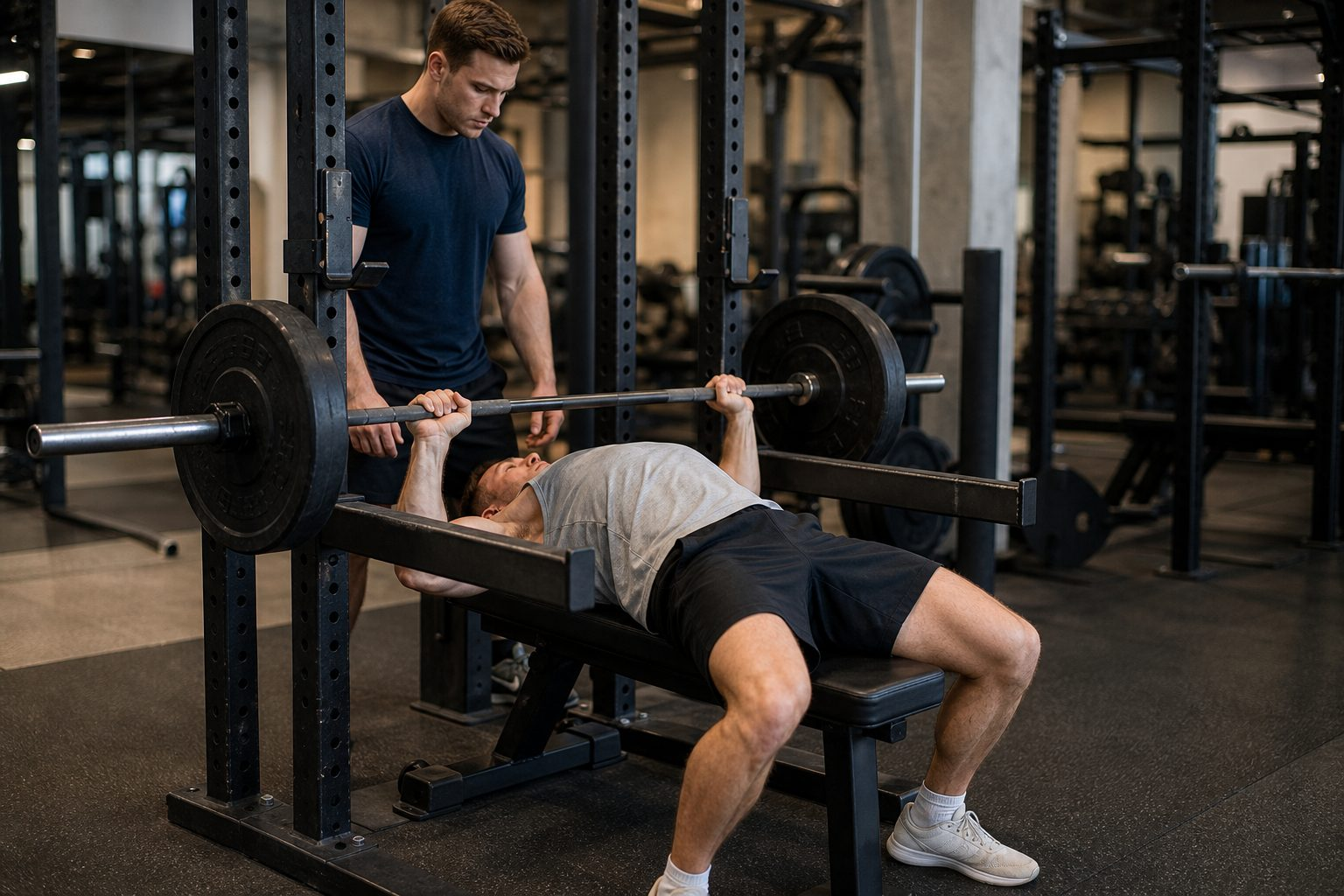
The simple answer
A solid bench press uses five connected steps:
- Choose a grip that keeps your wrists above your elbows.
- Plant your feet and create full-body tension.
- Unrack without losing your upper-back position.
- Lower the bar toward your lower chest with control.
- Press it upward and slightly back until it finishes over your shoulders.
The bar should usually follow a shallow arc, not a perfectly vertical line.
Set your grip width
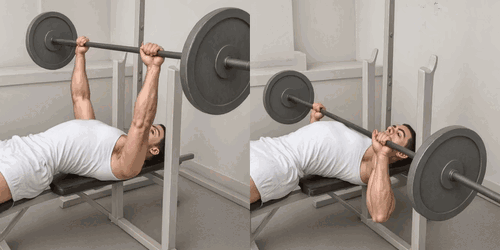
A closer grip generally increases the demand on your triceps. A wider grip can increase chest involvement and shorten the bar’s range of motion, but excessively wide grips may feel rough on the shoulders.
Start with a moderate grip. At the bottom of the repetition, your forearms should appear vertical when viewed from the front. Your wrists should be stacked over your elbows rather than angled inward or outward.
A practical way to estimate your starting position is:
- Lie on the bench with your arms extended.
- Pull your elbows back until they are bent roughly 90 degrees.
- Bring the elbows slightly toward your sides.
- Use the resulting hand distance as your initial grip width.
- Adjust after warm-up sets based on wrist, elbow, and shoulder comfort.
Grip the bar with your thumbs wrapped around it. A full grip is more secure than placing your thumbs on the same side as your fingers.
Keep your wrists close to straight by pointing your knuckles toward the ceiling. Letting the bar roll toward your fingers bends the wrists back and makes force transfer less efficient.
Build a stable setup
Your body should not be passive on the bench. Stability from your legs, torso, and upper back gives your chest and arms a stronger base from which to press.
Position yourself with your eyes roughly under the bar. Plant your feet firmly, ideally with your knees level with or slightly below your hips.
Then create tension:
- Push your feet into the floor.
- Tighten your quadriceps and glutes.
- Pull your shoulder blades back and slightly down.
- Lift your chest without letting your hips leave the bench.
- Take a deep breath into your abdomen and brace your trunk.
A slight upper-back arch is normal and often makes the movement more comfortable. You do not need an extreme arch. The goal is a stable rib cage and chest position, not the shortest possible repetition.
Your head, upper back, and glutes should remain in contact with the bench. Your feet should stay planted throughout the set.
Unrack without losing tension
Many lifters create a good setup and immediately lose it while unracking.
Avoid reaching so far backward that your shoulders come away from the bench. Push the bar out of the hooks, then bring it forward until it is directly above your shoulders.
If the rack position forces you to shrug or flatten your upper back, adjust the hook height. The bar should be high enough to clear the hooks without a partial press, but low enough that you can unrack it without lifting your shoulders.
Use a spotter for challenging sets. If you train alone, set the rack’s safety arms so they catch the bar without interfering with a normal repetition.
Control the descent
Lower the bar toward your lower chest or sternum area. Do not simply let gravity drop it.
Think about pulling the bar down under control while keeping your shoulder blades stable. Your elbows should generally remain about 45 to 70 degrees away from your torso.
Avoid both extremes:
- Elbows flared directly outward: This can make the shoulders feel exposed and unstable.
- Elbows pinned tightly to your sides: This turns the lift into a more triceps-dominant press and may create an awkward wrist position.
The exact angle depends on your grip width and body structure. What matters most is that the elbows track consistently and remain under the wrists.
For many lifters, the bar can touch the lower chest. But touching is not mandatory if your shoulders roll forward or become uncomfortable near the bottom. Use the deepest range you can control while maintaining your upper-back position.
Pause, then press back
The bottom position places the chest under substantial stretch and is valuable for muscle growth. Do not waste it by bouncing the bar off your chest.
Pause lightly for around half a second. Keep your legs, upper back, and grip tight. The bar may touch your shirt, but it should not sink into your torso or come to rest without tension.
Begin the ascent by driving your feet into the floor and pressing the bar upward and slightly back toward your head. It should finish over your shoulders, where the bar is easiest to balance.
Maintain your chest position as your arms straighten. Do not round your shoulders forward at the top just to move the bar another centimetre.
Exhale near the top, take another controlled breath, brace, and begin the next repetition.
Common bench press mistakes
Using too much weight
If the bar drops quickly, bounces off your chest, or changes direction between repetitions, the load is too heavy for productive technique work.
Reduce the weight until every repetition follows a similar path.
Moving your feet
Shuffling or lifting your feet removes part of your stable base. Set them before unracking and keep pressure through the floor.
Lifting your glutes
Leg drive should push your body toward the rack, not launch your hips off the bench. Keep your glutes in contact with the pad.
Forcing an uncomfortable depth
A full range of motion is useful when you can control it. It is not useful when your shoulders roll forward or the bar crashes into your chest.
Use a slightly reduced range while working on control, setup, and mobility.
Changing technique every session
Grip width, touch point, and elbow position need time to become consistent. Make small adjustments during warm-ups, then keep your setup stable long enough to evaluate it.
How to apply this in your training
Perform several progressive warm-up sets before your working weight. For example:
| Set | Load | Repetitions |
|---|---|---|
| Warm-up 1 | Empty bar | 10–15 |
| Warm-up 2 | About 40% of working weight | 8 |
| Warm-up 3 | About 60% | 5 |
| Warm-up 4 | About 75–80% | 2–3 |
| Working sets | Planned load | 5–10 |
These percentages are guides, not strict rules. Heavier working sets may require more preparation.
For muscle growth, start with three working sets of 6–10 controlled repetitions. Finish most sets with roughly one to three good repetitions still available. When you reach the top of your repetition range across all sets with stable technique, increase the weight by the smallest practical amount.
Track more than the load. Record your repetitions and note whether the bar path, pause, and touch point remained consistent.
How Gymfile helps
Bench press progress is easier to judge when you can compare actual sessions instead of relying on memory.
Gymfile helps you track sets, repetitions, weights, rest periods, and previous performance. That makes it easier to see whether your bench press is improving and whether a weight increase is justified.
Keep your technique consistent, progress in small steps, and treat clean repetitions as the standard. A heavier bar only represents progress when you still control it.