5 Glute Training Mistakes That Limit Growth
July 2, 2026
If your glutes are not growing, the problem is usually not effort. It is exercise selection, execution, or programming.
Strong glutes matter for more than appearance. They help with hip power, squats, deadlifts, sprinting, and often make lower-body training feel better and more stable.
The simple answer
For better glute growth, focus on heavy hip extension, use form that actually biases the glutes, and train them through more than one resistance profile.
That means your program should include:
- A squat or leg press pattern
- A hip hinge pattern
- A split squat or lunge pattern
- A hip thrust or similar movement where the glutes work hardest near lockout
- Enough weekly hard sets to progress without turning the workout into junk volume
The gluteus maximus is the main muscle you are trying to build. It is the biggest part of the glutes and its main job is hip extension: driving the hips forward.
The smaller glute muscles still matter for hip stability and shape, but they should not replace your main glute-building work.
Why glute training often goes wrong
Most people train glutes in one of two bad ways.
They either do random “burn” exercises with very little load, or they do solid lower-body exercises with form that shifts most of the work to the quads, hamstrings, or lower back.
You can feel tired after both. You can even get sore.
But soreness and fatigue do not prove that the target muscle is getting the best stimulus.
For muscle growth, you need repeatable exercises, enough load, good range of motion, and progressive overload. If you cannot track it and improve it over time, it is probably not the foundation of your glute training.
Mistake 1: Choosing exercises that do not load hip extension well
The glutes grow best when they are forced to extend the hip against meaningful resistance.
Good glute-focused exercises are not complicated. They are usually the basics:
- Squats
- Leg presses
- Bulgarian split squats
- Romanian deadlifts
- Deadlifts
- Hip thrusts
- Back extensions or hip extensions
The key is not whether an exercise is trendy. The key is whether it lets you train hard, use enough load, and progress over time.
Small isolation-style movements can have a place. Cable kickbacks, abduction work, and band work can help you feel the glutes and add extra volume. But they should not be the whole plan if your goal is serious growth.
A useful rule: build your glute training around exercises where you can clearly track reps, load, and execution.
Mistake 2: Turning every lower-body lift into a quad exercise
Many lifters think they are training glutes, but their form says otherwise.
On squats, leg presses, lunges, and split squats, your shin and torso angle change the emphasis.
More forward knee travel usually increases quad involvement. More hip flexion and a slightly more forward torso usually increase glute involvement.
That does not mean knees-forward squats are bad. They are not. It just means they may not be the best choice if your main goal in that exercise is glute bias.
For a more glute-focused leg press:
- Place your feet slightly higher on the platform
- Use a stance that lets your knees track cleanly
- Control the lowering phase
- Avoid going so deep that your hips curl off the pad
- Think about driving through the midfoot and heel
- Stop the set when form starts changing
For Bulgarian split squats or lunges:
- Take a slightly longer stance
- Let the torso lean forward from the hips
- Keep the spine neutral
- Push through the front foot
- Do not bounce out of the bottom
- Keep the front knee stable, not collapsing inward
You should feel more tension around the glute of the front leg, especially near the bottom of the rep.
Mistake 3: Letting the lower back and hamstrings take over
Hip hinges are great for glutes, but they are easy to misload.
Take the Romanian deadlift. It can be a strong glute and hamstring builder. But if you force the range of motion too far, your lower back may start doing work it should not be doing.
The goal is not to touch the floor.
The goal is to push the hips back, keep the spine neutral, load the posterior chain, and stop when your hips cannot move back any further without your back rounding.
For a more glute-friendly Romanian deadlift:
- Use a soft knee bend
- Push your hips back, not just the weights down
- Keep the bar or dumbbells close
- Stop the descent when your pelvis stops moving back
- Keep your ribs down and spine neutral
- Drive the hips forward to stand tall
- Do not overextend your lower back at the top
Straight legs will usually shift more tension toward the hamstrings. A slight knee bend often helps you load hip extension better.
Your lower back should feel stable and involved. It should not be the main muscle limiting the set.
Mistake 4: Only training the glutes in the stretched position
Many great glute exercises challenge the muscle most in the bottom position.
Examples include squats, leg presses, split squats, and Romanian deadlifts. These are valuable because the glutes are loaded when lengthened, and research generally supports loaded stretch as an important part of hypertrophy training.
But if every glute exercise in your plan is hardest at the bottom, you may be missing useful work where the glutes are hardest near full hip extension.
That is where hip thrust-style movements are useful.
A good glute program usually includes both:
| Exercise type | Where it is hardest | Examples |
|---|---|---|
| Squat / split squat / hinge | Bottom or stretched position | Squat, leg press, Bulgarian split squat, Romanian deadlift |
| Hip thrust / bridge pattern | Top or shortened position | Hip thrust, glute bridge, hip thrust machine |
This does not mean hip thrusts are mandatory for everyone. But they are a very practical way to train the glutes hard in the shortened position.
Mistake 5: Skipping activation when you cannot feel your glutes
“Activation” is often overhyped.
You do not need 20 minutes of bands before every lower-body session. You also do not need to feel a perfect mind-muscle connection on every rep for growth to happen.
But if you consistently feel only quads, hamstrings, or lower back during glute-focused lifts, a short activation warm-up can help.
Keep it simple:
- 1–2 light glute bridge sets
- 1–2 controlled bodyweight hip hinges
- 1–2 light abduction sets
- A few slow warm-up reps of your first main lift
This should take 5 minutes, not half the workout.
The goal is to improve control before loading. Activation work is a tool, not the main event.
Practical glute training rules
Use these rules as a starting point.
1. Train glutes 2 times per week
Most lifters do well training glutes twice per week.
That gives you enough frequency to practice the movements and enough recovery to train hard.
2. Start with 8–14 hard sets per week
For beginner-to-intermediate lifters, 8–14 hard glute-focused sets per week is a good starting range.
You can go higher, but only if:
- Your performance is stable or improving
- Your joints feel good
- Your lower back is not constantly tired
- You are recovering between sessions
- You are not just adding sets because you are impatient
3. Keep most sets 1–3 reps from failure
You do not need to max out every set.
For heavy lower-body movements, stopping with 1–3 reps in reserve is usually enough. For safer machine or isolation work, you can push closer to failure more often.
4. Progress one variable at a time
Progression can mean:
- More reps with the same weight
- More weight for the same reps
- Better depth
- Better control
- More stable form
- More total weekly volume if needed
Do not change everything at once. If you add weight, keep the form standard the same.
Example glute-focused workout
This is a simple session you can use as one of your weekly lower-body workouts.
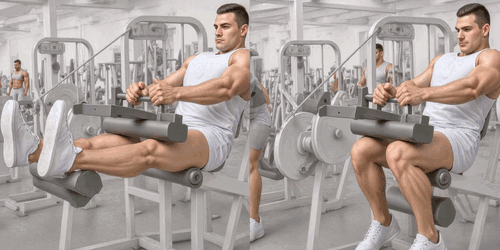
It combines a heavy press pattern, a single-leg movement, a hinge, and a top-position glute movement.
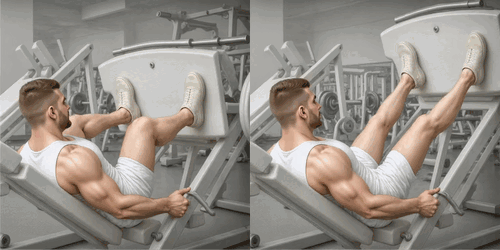
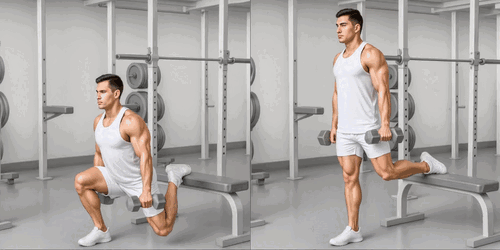
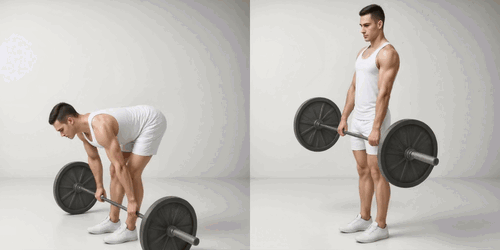
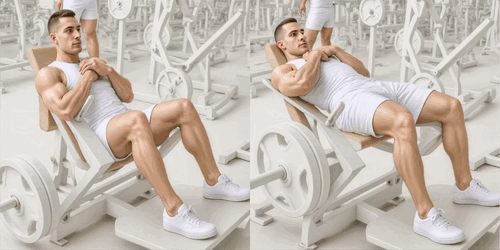
Suggested loading:
- First exercise: 3–4 sets of 6–10 reps
- Second exercise: 3 sets of 8–12 reps per side
- Third exercise: 2–4 sets of 6–10 reps
- Fourth exercise: 3 sets of 8–15 reps
- Final hamstring movement: 2–3 sets of 10–15 reps
Rest 2–3 minutes on heavy compound lifts. Rest 60–120 seconds on smaller movements.
Common mistakes to avoid
Chasing burn instead of progression
A burn can happen with very light work. That does not make it productive.
Track your working sets. If your reps and loads never improve, your glutes have little reason to grow.
Going too deep with bad pelvic position
Depth is useful when you can control it.
If your hips tuck under hard at the bottom of a leg press or squat, you may be going past your useful range. Use the deepest range you can control without your lower back taking over.
Using hip thrusts as a lower-back extension
At the top of a hip thrust, finish by squeezing the glutes, not by arching the spine.
Keep ribs down. Lock out through the hips. Stop when the torso is straight.
Changing exercises every week
You cannot track progress if the plan keeps changing.
Keep your main glute exercises stable for at least 6–10 weeks. Rotate only when progress stalls, pain appears, or the exercise clearly does not fit your body.
How Gymfile helps
Glute training improves when you stop guessing.
Gymfile helps you track your exercises, sets, reps, weights, rest times, and progress over time. That makes it easier to see whether your glute lifts are actually moving forward or just feeling hard.
You can also review your routine structure and avoid the common trap of doing too many random exercises with no clear progression.
Want to make your training easier to manage? Learn more at gymfile.de or download the iOS app here: Gymfile on the App Store.
Summary
If you want stronger, better-developed glutes, do not build your plan around random burn work.
Focus on loaded hip extension. Use form that biases the glutes when that is the goal. Include both stretched-position and shortened-position work. Track your lifts long enough to see real progression.
Simple works. But only if you execute it well and measure it.